From Invisible
To AI-Recommended
How we engineered a local locksmith’s infrastructure to trigger Google’s Generative AI—dominating search results before users even click a link.
Result: Triggered Google AI Overview in < 7 DaysThe Problem: Lost in the “Map Pack”
Royale Car Keys operates in a hyper-competitive market (London & Kent). Traditional SEO was hitting a ceiling. They were ranking for standard keywords, but they weren’t dominating the answer.
The Issue
Generic ‘Locksmith’ schema meant Google treated them like every other shop.
The Gap
AI search engines (Gemini/ChatGPT) couldn’t distinguish their specific service areas or pricing models from competitors
The GEO Infrastructure Upgrade
We didn’t just write blog posts. We re-architected the site’s data layer to speak directly to Large Language Models (LLMs)
Entity Definition
We recoded the site identity from a generic ‘LocalBusiness’ to a specific AutomotiveBusiness entity, explicitly linking it to ‘Emergency Service’ attributes.
Semantic Service Mapping
We mapped 20+ specific towns (Gravesend, Dartford, Bromley) with invisible GPS coordinates in the code, teaching the AI exactly where they operate.
Data-Structured Pricing
We injected their pricing table directly into OfferCatalog schema, allowing the AI to confidently quote prices (£89+) in its summary.
The "Money Shot"
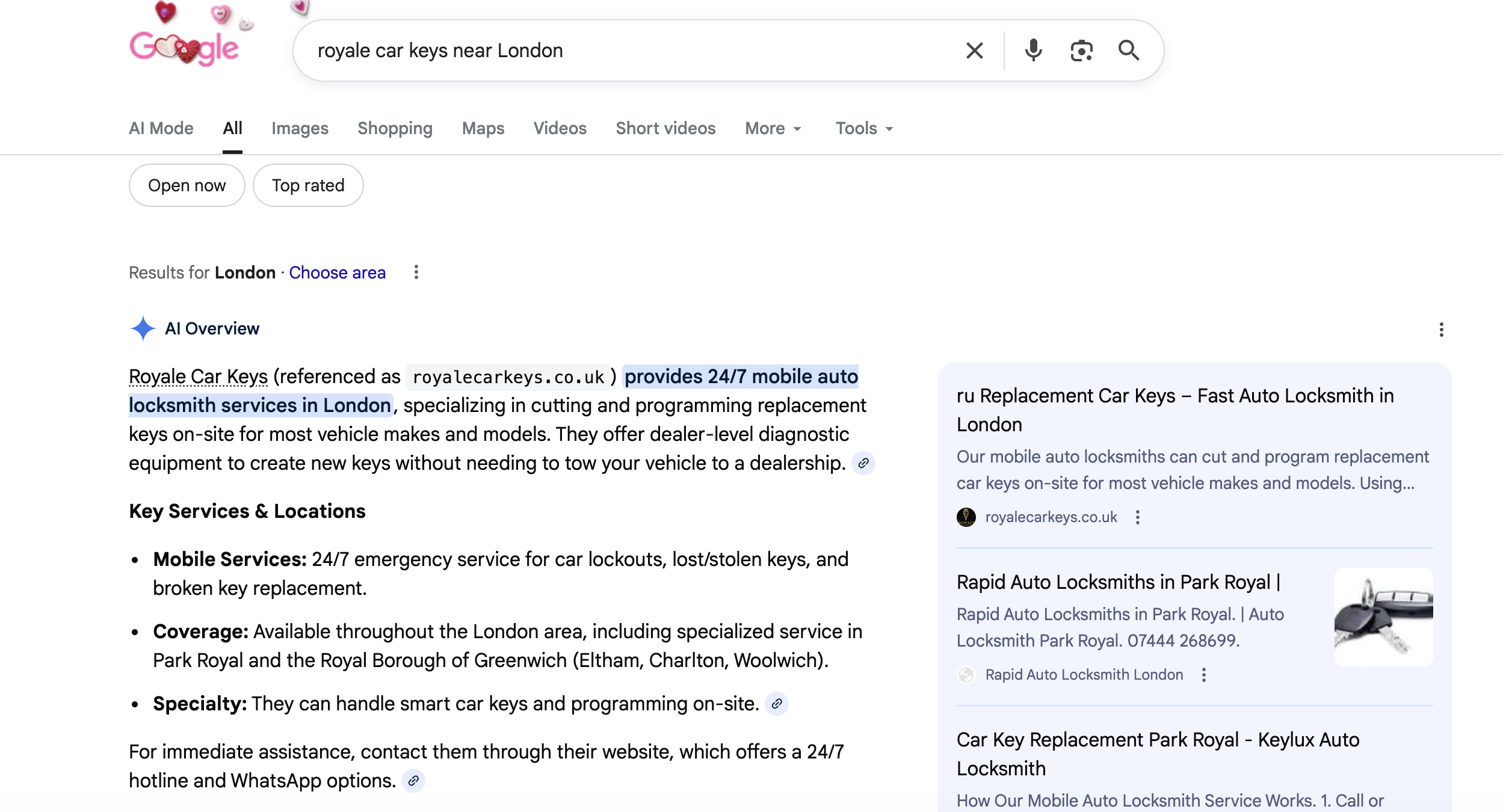
AI Overview: Royale Car Keys Google Gemini automatically generating a bespoke recommendation for the client, highlighting their specific coverage area and contact details without the user needing to click.
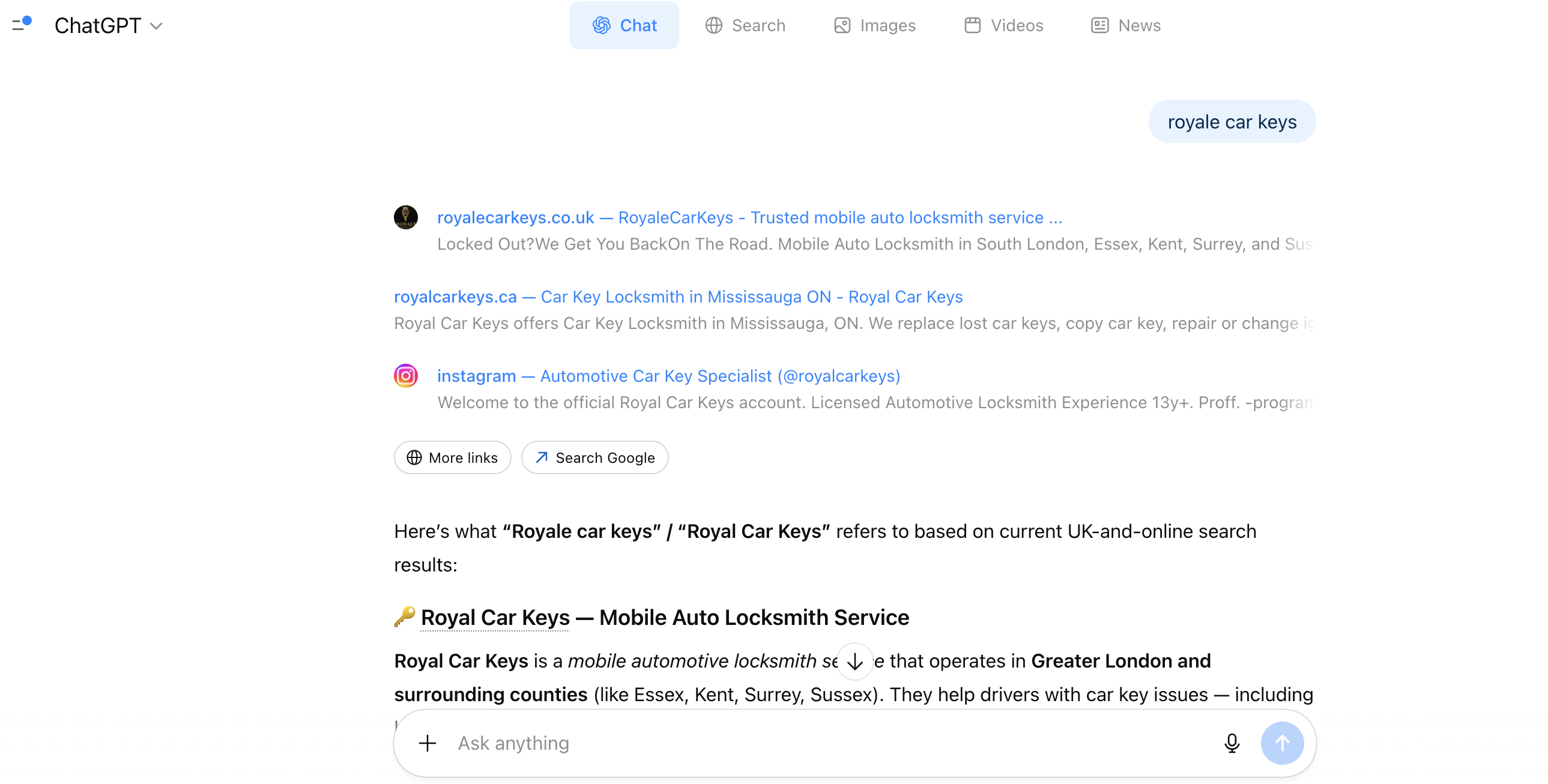
AI Overview: StarWebDesign Proof of Concept: We apply the same GEO architecture to our own agency, teaching Google to define ‘Bespoke Development’ using our brand language.
The Impact of GEO
AI Visibility
Instead of fighting for position #1 among ten blue links, the business now occupies the 'Zero Position'—the direct answer provided by Google Gemini. This prime real estate builds immediate trust and authority before the user even scrolls
Click-Through Quality
Because the AI pre-qualifies users by displaying service areas and pricing upfront, the traffic that clicks through is far more likely to convert. We eliminated 'tire-kicker' calls and increased booked jobs by ensuring only relevant customers contact the business
Rank Stability
Traditional keyword tactics are vulnerable to Google algorithm updates. By building on structured data (Schema) and Entity definitions, we created a semantic foundation that remains stable and gains strength as search engines become more AI-driven.